The 3-4-4-3 Custody Schedule: How It Works, With Examples
Last updated: October 2026
The 3-4-4-3 custody schedule splits parenting time equally using blocks of three and four nights. Parents find it by searching "3-4-4-3 schedule" or "3 4 4 3 parenting plan," and it is one of the less-explained 50/50 options, so it is worth laying out night by night.
What the 3-4-4-3 schedule means
The four numbers are four blocks in a row, and the full set of four covers a two-week cycle. Parent A has three nights, then Parent B has four, then Parent A has four, then Parent B has three. Then the whole pattern starts over with Parent A.
Each parent ends up with seven nights out of every fourteen, split into one three-night block and one four-night block.
A two-week example
Anchored to a Monday start, one common version looks like this:
- Parent A has Monday, Tuesday, and Wednesday (3 nights).
- Parent B has Thursday, Friday, Saturday, and Sunday (4 nights).
- Parent A has Monday, Tuesday, Wednesday, and Thursday of the second week (4 nights).
- Parent B has Friday, Saturday, and Sunday of the second week (3 nights).
Each parent has seven nights across the fourteen days. With a Monday start, Parent B ends up with both weekends and Parent A has none. From one week to the next, only one weekday switches parents, so no start day alternates whole weekends. A different start day can split each weekend between the parents instead, and families who want alternating weekends often look at 5-2-2-5. Families can also shift which days fall in the three-night and four-night blocks to line up with a work shift or a school event. That is fine as long as the totals stay even and the exact days are written down.
Who the 3-4-4-3 schedule works for
- Families who want an even split without the two-night blocks of a 2-2-3 schedule.
- School-age children who can handle three or four nights away from one parent.
- Parents who can manage four exchanges every two weeks, the same number as a 5-2-2-5 schedule and fewer than the six a 2-2-3 schedule needs.
How 3-4-4-3 compares to other 50/50 schedules
- 2-2-3 hands off every two or three days, with six exchanges every two weeks. 3-4-4-3 needs four, and its longest stretch is four nights instead of three.
- 5-2-2-5 keeps the same weekdays with the same parent every week and only alternates the weekend. 3-4-4-3 moves every block, so it takes longer to memorize.
- Week-on-week-off has two exchanges every two weeks and a seven-night stretch. 3-4-4-3 caps the longest stretch at four nights, which some families prefer for younger children.
For the complete side-by-side comparison, see which 50/50 custody schedule works.
Common mistakes with a 3-4-4-3 schedule
- Treating the four-number label as self-explanatory. Two families can both say "3-4-4-3" and mean different days, so write out the actual dates for the first full cycle.
- Not naming an anchor date. Every rotation needs one fixed starting day both parents agree on, or the count drifts after the first missed exchange.
- Letting a holiday or school break override the pattern without writing down which days were swapped and why.
- Tracking exchanges from memory. A rotation with two different block lengths is harder to reconstruct months later than a simpler pattern, which makes a written record more useful, not less.
Keeping the schedule and the swaps on the record
Because 3-4-4-3 rotates through two block lengths, it is easy to lose track of once a few swaps have happened.
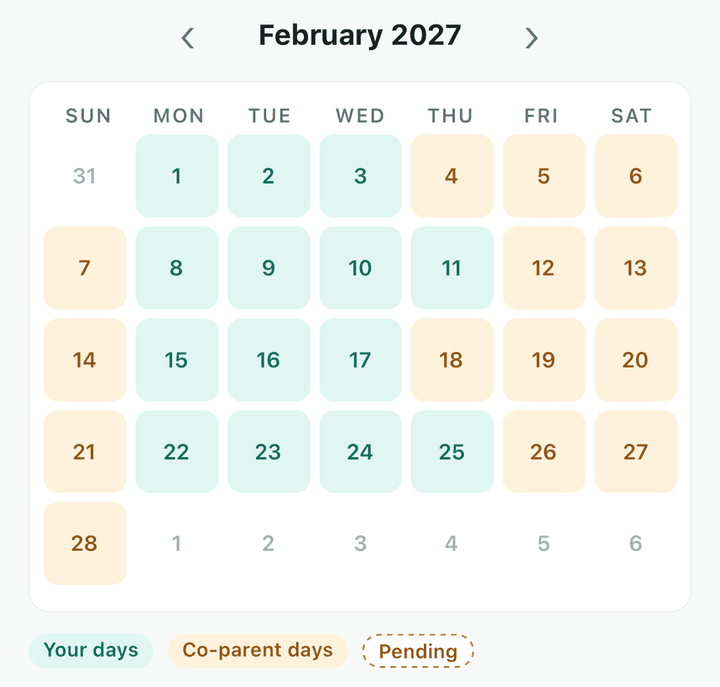
SharedAnchor's custody pattern engine lays out your 3-4-4-3 rotation automatically from the start date you set, and every swap is logged as a dated override instead of something either parent has to remember. Because that history is a record neither of you can quietly change after the fact, there is a dated record to point to if the schedule is ever questioned.
Once the schedule is settled, see how to set up a co-parenting expense agreement for the money side, and how to make your child-expense records court-admissible for keeping that side of the record just as solid.
Questions co-parents ask
Is 3-4-4-3 the same as 4-3-3-4? No. The block lengths are the same numbers, but the starting block differs, which changes who has the longer stretch first. Confirm the exact starting sequence before assuming two written plans match.
Is 3-4-4-3 better than 2-2-3 for young children? Not necessarily. Its longest stretch (four nights) is longer than 2-2-3's (three nights), so families of very young children often still prefer 2-2-3 despite the extra exchanges.
How many exchanges does 3-4-4-3 involve per month? About eight or nine. There are four exchanges in every two-week cycle, or two a week.
Does the schedule pattern affect child support? Not directly. Support is generally set by each parent's income under your state's guidelines, though the total overnight count can be one input in some states. Ask a family-law attorney about your state's rules.
SharedAnchor organizes co-parenting schedules and records. It is not legal advice; custody schedules and overnight counts have legal consequences, so consult a licensed family-law attorney for your situation.
Want your 3-4-4-3 schedule and every swap in one shared record? See how SharedAnchor pricing works - one plan covers both co-parents.